
In recent years, a growing number of pregnant women have been participating in water activities. International estimates indicate a frequency between 20% and 40% in settings where these paths are available, with differences related to the organization of services and the spread of programs dedicated to motherhood. The most common reasons do not concern physical performance, but the need to manage bodily changes more comfortably.
Many women report a reduction in the feeling of weight, greater freedom of movement and a more balanced perception of their body. To these aspects are added the search for a gentle activity, relief from lower back pain, and the desire for a protected social context. In this scenario, water becomes an environment where the pregnant body faces different physical conditions compared to dry land.
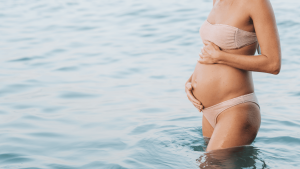
Pregnancy involves progressive changes involving posture, balance, respiration, and the circulatory system. The center of gravity shifts, the spine changes its alignment, joints become more mobile due to ligament laxity, and the diaphragm works in a progressively reduced space. Immersion introduces a set of forces that change body perception. Hydrostatic thrust reduces weight-bearing, body weight is distributed evenly, and movement takes on characteristics less constrained by gravity.
Physiological effects of immersion
At a physiological level, an increase in venous return is observed with a redistribution of fluids towards the chest. Breathing tends to become more regular and deep, while lumbar and cervical muscles experience a decrease in tension related to weight-bearing on land.
Movement in water takes on a different quality compared to the aerial environment. Walking slows down, pelvic rotations become wider, and the global coordination of the limbs integrates more with body balance. Contact with warm water results in a uniform stimulation of the body surface, which favors a more continuous perception between posture and breathing and a greater awareness of bodily sensations.
The experience of water in the different stages of pregnancy
The path in water varies in the different stages of pregnancy:
- In the first months the experience is oriented toward familiarization and light movement;
- In the second trimester the continuity of body work increases thanks to greater stability;
- In the final stages water allows for a reduction in the perception of load, facilitating global movement.
The activities proposed in the courses include gentle mobilization, breathing exercises, and moments of relaxation, adapted to individual response and the gestational period.
Indications and safety aspects
The main obstetric and gynecological scientific societies, including SIGO (Italian Society of Gynecology and Obstetrics), indicate that physical activity in pregnancy, in the absence of medical contraindications, can be maintained and adapted to the gestational period. Guidelines emphasize that movement in an aquatic environment is considered a low-impact activity, with the need for individual clinical evaluation before starting structured programs.
Before starting, a consultation with the relevant healthcare professional is recommended to rule out any contraindications. Water temperature is generally between 30 and 32 degrees, a value that promotes comfort without excessive physiological stress. Sessions have an average duration of between 40 and 60 minutes, with the possibility of adjustment based on individual tolerance.
Swimming pool and sea: two experiences compared
Aquaticity in pregnancy can be practiced in a swimming pool or in the sea, with environmental differences influencing the experience.
In the swimming pool
The swimming pool offers controlled conditions, with stable temperature, absence of currents and predictable depth. In summer, when outside temperatures are high, it is useful to avoid entering the water immediately after prolonged exposure to the sun, hydrate adequately before and after the session, and prioritize cooler times of the day. After activity, it is advisable to dry off and change quickly to avoid cooling related to evaporation.
At sea
The sea introduces variability related to waves, salinity and uneven seabeds. In pregnancy, it is preferable to choose beaches with gradual access to the water, avoid rough sea conditions and prefer accompanied entry. In this case too, it is useful to avoid the hottest hours, protect the skin with adequate photoprotection and maintain good hydration. The time spent in water should be shorter than in the pool, with attention to fatigue and body temperature.
In both contexts, water allows for a different mode of movement and body perception, integrating physiological adaptation and sensory experience within the gestational path.
