
By the Mountain Pediatrics Study Group of SIP with the collaboration of the Central Medical Commission of the CAI
Returning to the mountains seems like a return to normality these days, but returning to the mountains with children is something more: it is finding another return and other needs, those that marry the environment and nature, offered for the discovery of the little ones.
This is the theme that was proposed for the reflection of the Pediatrics Study Group (GdS) of Mountain of the Italian Society of Pediatrics (SIP) and also the first topic on which we met with colleagues from the Central Medical Commission of the CAI which has a working group dedicated to Children and the Mountains.
We therefore intend to take up and suggest reading the Italian Alpine Club magazine “Montagne 360”, which in May dedicated its cover and extensive space to the theme of children “from zero to five years in the mountains”.
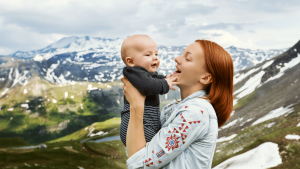
A first part was dedicated to the theme of “outdoor families, the educational value of nature, the healthiness of the air in the woods and along the trails, the possibility of offering children experiences of open spaces, movement, and responsible adventure”.
A further contribution was then dedicated to the first steps in the mountains and the theme of the Family CAI experience which promotes “an approach to naturalness where solid trust chains are created within the family”.
The freedom of spaces and the physical well-being promoted by frequenting the mountains are indeed important elements that can strengthen the child-parent bond. The mountain is an ideal environment for promoting emotional inclusion experiences. For this reason, the theme of “high-altitude experiences with children” was also addressed, an excellent way to spend quality time while also dealing with practical aspects such as changing diapers, keeping baby food warm in a thermos, meticulous route planning and what to pack in the backpack.
The Central Medical Commission of the CAI handled the central part of these contributions: contact with nature as an important stimulus for the balanced growth of children through the relationship with its manifestations and its rhythms.
The theme of rhythms, destinations, and times that must be tailored to children and parents, and the importance of a safe place, possibly identified as a shelter along the route. This contribution also reminds us how children live primarily through their senses and how there is a correspondence between the rhythms of nature and those of growth.
How the natural environment has a significant positive influence not only on cognitive but also on emotional growth, notably improving concentration skills, encouraging creative play, facilitating positive interaction between children and adults, and becoming a bridge between the external world and one’s inner world.
Going to the mountains can be “a worthwhile effort” if conducted in the right way, if it is a game for the child, if it becomes a reason for gratification and self-esteem. Most important is the “quality relationship with the earth, which allows the child not only to grow in good health but also to feel responsible for protecting nature, learning to take care of something or someone outside of themselves”.
Instilling responsibility is also a reason to remember and remind us that going to the mountains, no differently than other nature activities, requires attention to safety and some useful principles to remember: “even very young children, as long as they are in good health, can go to the mountains and stay even for long periods at the altitudes typically inhabited in the Alps, between 1500 and 2000 meters.” But it is also necessary to be aware that the environmental adaptation of young children is very different from that of adults and particular attention must be paid to the temperature, especially the cold and the risk of hypothermia.
The use of suitable clothing is therefore important, as is the availability of sunscreen, a hat, and sunglasses.
There is no reason to involve children in the challenge of summits at altitudes for which specific preparation and training are needed. For example, one should always avoid exposing children to rapid changes in altitude, which occur in cable cars and sometimes even in cars, before school age. The change in barometric pressure can indeed cause ear pain and sometimes lead to ear infections, as can happen on a plane. The things to do are indeed similar, such as having the child suck or chew to help balance the environmental pressure with the internal pressure of the ear.
Let’s try to take up and organize some important observations:
- It is not recommended to ascend or descend quickly with infants or toddlers from altitudes above 1600 m in particular this should be avoided with premature infants or those at risk for anemia or with respiratory or heart conditions;
- Altitude sickness can always occur in pediatric age if ascending rapidly in altitude, especially above 2500 m and especially if the child is already tired, if the temperature is very cold, or if the child suffers from respiratory diseases or heart disease. It is important to know that in these situations, the child may exhibit non-specific symptoms such as significant fatigue, irritability, headache, nausea, loss of appetite, but also vomiting and sleep disturbances that require an immediate return to lower altitudes;
- In the mountains, it is also necessary to pay attention to insect bites, especially those from hymenoptera and especially if the child is allergic and has already had reactions to hymenoptera venom. In this case, even in the mountains, it is necessary to have life-saving medications such as adrenaline, antihistamines, and cortisone, and to be prepared for the correct use of medications that must always be in the backpack;
- More frequent and insidious, however, are tick bites in the mountains, especially in tall grass, and for this reason, it is important to have suitable footwear but also clothing and headgear capable of protecting the legs, arms, torso, and head. Knowing how to behave, how to recognize ticks, and how to remove them from the skin is important, and the pediatrician should be consulted beforehand both to learn these maneuvers and to possibly schedule the TBE (Tick Borne Encephalitis) vaccination if visiting the Alpine areas of Trentino Alto Adige, Belluno, and Friuli Venezia Giulia.
The mountain is not, however, just a collection of dangers; what is important is knowing how to experience it safely and how to plan activities with children. For this reason, we are attaching to these recommendations a sheet with the Children and Mountains decalogue produced by the Central Medical Commission of the CAI, with whom we want to collaborate, and which is dedicated to parents and caregivers.
Children and the Mountains: Decalogue of the CAI Medical Commission
- Safety and prudence first. Always check the forecast weather conditions. Do not risk it if conditions are not favorable and remember that for a child, going to the mountains means observing nature, being with friends and parents, and going on an adventure. The walk should not be stressful. Do not push unsustainable rhythms: there is no race to win, no records to break.
- Remember that you are dealing with children. Especially little ones, under 3 years old, have not yet well-developed thermal regulation and adaptation to the reduction in oxygen pressure when ascending, even quickly, to high altitudes.
- Assess the altitude to be reached. If the child is only a few months old, it is prudent not to go above 1500 meters, if under 2 years old above 2000 meters, if between 2 and 5 years old above 2500-3000 meters.
- Pay attention to acute mountain sickness. Acute mountain sickness (AMS) manifests with headache, insomnia, irritability, loss of appetite, apathy, constantly accelerated heart rate, nausea, and sometimes vomiting; children, especially if small, do not know how to appropriately describe the symptoms they feel. It manifests primarily during the first night of the stay at altitude. If AMS is suspected, descend quickly.
- Keep in mind the child’s basic health status. Avoid taking children above 2000 meters in any case if they are anemic, suffer from acute or chronic respiratory diseases that are not well-controlled, or from heart diseases.
- Pay attention to sudden altitude changes. In the presence of cold symptoms, be careful with ascents and/or descents using cable lifts that could cause ear pain.
- Protect skin, eyes, and head from solar rays. Use suitable glasses and reapply high-protection sunscreen during the trip; do not forget a peaked hat to protect them from heatstroke.
- Do not expose them to intense cold. Children are very sensitive to the cold and if carried for a long time in specific baby carriers, they should be covered more and occasionally removed from the backpack to let them walk, if possible, for short stretches.
- Choose the right clothing. Have them wear technical clothing if possible, suitable for the mountain climate; always carry spare dry clothes and a cape or a small umbrella in the backpack.
- Look after nutrition and hydration. Offer water or drinks enriched with mineral salts and with low glycemic content frequently and ensure you have sufficient easily digestible food supplies, avoiding foods rich in fats, sugars, and sugary drinks.
