
Pregnancy and childbirth open a phase of biological and functional transformation involving the endocrine system, tissues, musculoskeletal system, menstrual cycle, sexuality and body perception.
After the birth of the baby, the organism does not simply return to a previous condition, but moves towards a new physiological balance, the result of the integration of the changes that occurred during gestation, in which Feldman describes the concept of Maternal Body Image as the progressive reorganization of maternal body perception, shaped by the interaction between neuroendocrine settings, affective experience and early relationship with the newborn.
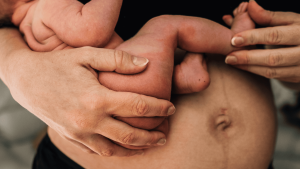
Tissue adaptations during pregnancy
As highlighted by the WHO (2022), during pregnancy the high concentration of estrogens, progesterone and relaxin promotes a marked tissue adaptability. Collagen, a fundamental structural component of the extracellular matrix, increases its turnover through remodeling processes that make tissues more plastic and adaptable. This allows the uterus to expand, the abdominal wall to modify its architecture and the pelvic floor to respond to new biomechanical needs. Elastic fibers contribute to the capacity for distension and elastic return, supporting a dynamic balance essential for pregnancy.
Postpartum tissue reorganization
After childbirth, the abrupt reduction in placental hormones initiates a phase of tissue reorganization.
Collagen and elastin undertake a gradual remodeling path that progressively leads to greater structural stability and a recovery of skin tone. This process explains the evolution of the abdominal wall, skin quality and fascial system, which over time reach a new condition of functional balance.
Abdominal diastasis and functional recovery
Diastasis recti abdominis, linked to the stretching of the linea alba, is approached as a dynamic condition. Recovery depends on:
- quality of connective tissue
- activation of deep muscles.
- core functionality.
Pelvic floor and core physiotherapy contributes significantly to the improvement of stability, posture and body perception.
Postpartum endocrine transition
The endocrine system enters a phase of progressive recalibration. The reduction of estrogens and progesterone after placental delivery allows for the reactivation of the hypothalamic-pituitary-ovarian axis.
The resumption of the menstrual cycle represents a sign of this transition, although it does not necessarily coincide with the first ovulation.
In non-breastfeeding women, the cycle can resume within a few weeks, while, during breastfeeding, prolactin maintains a functional inhibition of the release of GnRH, with more variable timing for the resumption of ovarian activity. Initial postpartum cycles may show irregularities, with possible anovulatory or luteal phases not yet fully stabilized. Parallel to this, the vaginal mucosa and sexual response are affected by hormonal variations, particularly in conditions of hypoestrogenism.
Sexuality in the postpartum period
Sexuality in the postpartum period is part of a complex adaptation context. The reduction of estrogens can influence lubrication and vaginal sensitivity, while prolactin and oxytocin modulate desire and affective orientation, favoring a greater centrality of the bond with the newborn. Added to these elements are fatigue, sleep fragmentation and changes in body image. The resumption of sexual activity follows individual timing and is progressively integrated with the couple’s new balance.
Body and skin changes
The body goes through a phase of global reorganization involving skin, muscles and body composition. Skin changes, such as stretch marks and variations in elasticity, reflect the adaptation of connective tissue during pregnancy and subsequent remodeling. The skin gradually tends to redefine its tone through the rebalancing of collagen and elastin.
The hair represents a visible sign of hormonal transition. During pregnancy, the growth phase of the hair follicle is prolonged by estrogens; after childbirth, hormonal rebalancing leads many follicles into the shedding phase, a phenomenon known as postpartum telogen effluvium. This process is temporary and tends to resolve spontaneously.
Musculoskeletal system, energy metabolism and body composition
The musculoskeletal system is affected by the persistence of relaxin and postural changes related to pregnancy and newborn care. Increased ligamentous laxity and new biomechanical stresses can influence lumbopelvic stability. Functional recovery is achieved through core reactivation and postural rebalancing.
Energy metabolism reorganizes according to new needs. Breastfeeding, when present, contributes to higher caloric expenditure and promotes the mobilization of reserves accumulated during pregnancy. Body composition gradually evolves towards a new stability.
Maternal Body Image and body perception
The body perception changes significantly. The body is experienced not just as an aesthetic or functional structure, but as an element that sustained the pregnancy and that continues to participate in the relationship with the newborn. This reprocessing of body image takes time and is progressively integrated with the new maternal identity.
Overall, the return to the pre-pregnancy condition is configured as a path of biological and functional rebalancing. The endocrine system, menstrual cycle, sexuality, body structure and self-perception converge towards a new organization, which reflects the female organism’s ability to adapt, evolve and reach a condition of dynamic stability after pregnancy and childbirth.
