
The home environment is the first context in which the child develops their motor, cognitive, sensory, and relational skills. In the first three years of life, the child goes through a phase of intense transformation characterized by the progressive acquisition of new skills: head control, ability to grasp objects, rolling, sitting position, crawling, standing, and independent walking. Each new skill changes the relationship between the child and the surrounding space.
An environment that is appropriate during the first months can later become a source of new risks, when the child acquires greater mobility and exploratory capacity. The prevention of domestic accidents therefore requires a dynamic view of child development. Safety does not only depend on the elimination of hazards, but also on the ability to understand how the child observes, interprets, and uses the environment based on their level of neuromotor and cognitive maturation.
In the first years of life, in fact, the child progressively acquires the tools necessary to learn about the world through the body. The ability to perform an action, however, often precedes the ability to understand its risk. A child may be able to reach an object, open a drawer, climb onto a surface, or move quickly without yet having the cognitive maturity necessary to recognize the associated danger.
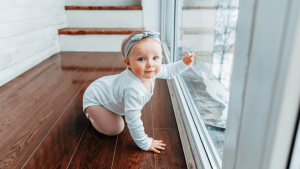
From 0 to 6 months: discovery of the body and first movements
In the first months, the newborn shows mainly spontaneous movements and progressively acquires greater motor control.
The main skills include:
- progressive head control;
- greater coordination between vision and hand movement;
- ability to grasp nearby objects;
- exploration through contact and the mouth.
At this stage, the child depends completely on the adult for their protection. Visual capacity is still in the phase of maturation and the perception of space is limited.
Even a small change in motor skills can quickly change the safety level. A child who initially remains still on a surface may later begin to rotate or move without easily predictable signals.
From 6 to 12 months: increase in mobility and active exploration
During the second semester of life, the child’s ability to interact with the environment increases.
There progressively appear:
- rolling;
- independent sitting position;
- movements on the floor;
- ability to grasp and manipulate objects;
- oral exploration.
The child uses hands, sight, and mouth to learn about what surrounds them. This exploratory mode is physiological and is part of development, but increases the risk of contact with small objects, inappropriate substances, or dangerous materials.
Perception of risk is still absent. The child does not understand the concept of danger and does not possess strategies to avoid harmful situations.
From 12 to 24 months: motor autonomy and expansion of the exploratory space
With the achievement of the upright position and walking, the child significantly increases their autonomy.
The new skills include:
- walking;
- carrying objects;
- climbing up and down;
- opening containers, drawers and doors;
- exploring different environments.
This phase is characterized by great curiosity and the desire to experiment. The child learns through movement, but still has limitations in coordination, balance, and prediction of consequences.
They can understand simple adult instructions, but do not yet have complete control over exploratory impulses. Improper management of the environment can favor:
- falls from stairs or furniture;
- access to dangerous products;
- contact with heat sources;
- handling small objects.
From 24 to 36 months: greater autonomy, but risk still present
Between the second and third year, the child develops a greater capacity for movement and communication.
The following improve:
- balance;
- motor coordination;
- ability to run and jump;
- language comprehension;
- ability to imitate adults.
Despite these improvements, the child continues to have a risk perception different from that of an adult. Curiosity can lead them to experiment with new situations without evaluating the possible consequences, because reasoning, self-control, and forecasting skills are still under development.
How risk changes with the increase in motor, sensory, and cognitive autonomy
The progressive acquisition of skills dynamically modifies the risk profile within the home environment. During the first months of life, the newborn presents a limited capacity for autonomous movement and safety depends mainly on the correct management of space by the adult. With neuromotor maturation, increased mobility, and greater exploratory capacity, the child progressively comes into contact with an increasing number of environmental stimuli.
Risk assessment must therefore consider four elements closely related:
- what the child sees, influenced by the development of visual function, the child’s height, and their spatial perspective;
- what the child wishes to reach, determined by curiosity, exploratory motivation, and interest in new stimuli;
- what the child is physically able to do, in relation to acquired motor skills, muscle strength, balance, and coordination;
- what the child is cognitively able to understand, in relation to the maturation of executive functions, attention, impulse control, and the ability to anticipate consequences.
The child does not interpret the environment with the same criteria as an adult. The perception of space is conditioned by the phase of neuromotor and cognitive development. In the first years, they learn mainly through direct experience and active exploration. Movement is a tool of knowledge, while the ability to recognize the situationsdangerous emerges gradually.
From the point of view of perceptual development, they can be strongly attracted by bright colors, sounds, particular shapes or else new objects. Interest in a stimulus can prevail over the assessment of the associated risk. Exploratory motivation is therefore physiological and necessary for development, but must be accompanied by an environment adequately organized.
Also the visual perspective is different from that of an adult. Reduced height, the different field of vision and less environmental experience modify the way in which the child perceives domestic spaces. Elements recognized as dangerous may not be interpreted in the same way by the child.
With the achievement of the upright position and independent walking, the possibility of further access to raised surfaces, furniture, drawers, equipment, and previously unreachable objects increases. At the same time, the ability to open containers, move objects, and manipulate different materials grows.
The prevention of domestic accidents must therefore be dynamic. The environment must be adapted not only to the child’s current abilities, but also to the new skills they might acquire in the short term.
Main domestic risks and preventive strategies
Falls
Falls constitute one of the most frequent accidental events in the pediatric age, particularly in the first years of life, when the child rapidly acquires new motor skills but has not yet developed full control over posture, balance, and coordination.
In the first months, the danger is mainly associated with the management of the environment by the adult. With the increase in autonomous mobility, the child can instead reach surfaces and spaces previously inaccessible.
The main risk factors include:
- increase in autonomous mobility and access to new areas of the house;
- presence of stairs;
- access to elevated surfaces, such as beds, sofas, changing tables, chairs, or furniture;
- instability of furnishings, such as unsecured rugs, objects in walkways, or items that can be used as support during initial attempts to climb;
From the child development perspective, the child tends to explore through movement and direct experimentation. Interest in an object or surface can prevail over the ability to recognize the risk: the fall can therefore occur not due to lack of attention, but as a consequence of a physiological developmental phase.
The main interventions include:
- organizing spaces in a way that promotes safe movement;
- removing obstacles in play areas and walkways;
- using appropriate protection systems for stairs, windows, and surfaces at risk;
- stabilizing furnishings that can be used as support or climbing points;
- supervising adequately during the phases of acquiring new motor skills.
The environment must be evaluated considering not only what the child knows how to do at the present moment, but also what they might learn to do in a short time.
Choking and ingestion of foreign bodies
The risk of choking and accidental ingestion of foreign bodies is closely related to the child’s neuromotor and behavioral development characteristics. In the first years, the mouth represents a tool for exploring the environment, through which the child explores shape, consistency, and size of objects. However, this exploratory mode increases the possibility of contact with small-sized or easily fragmented materials, with potential risk of choking or ingestion.
With the development of grasping, fine motor skills, and the ability to move independently, the child can reach and manipulate objects previously inaccessible.
The following must be carefully checked:
- toys not appropriate for the child’s age or development;
- small components separable from toys;
- button batteries;
- magnets;
- small objects;
- easily fragmented materials;
- objects left unattended in environments frequented by the child.
The safety of toys and objects must be evaluated considering not only the chronological age, but also the motor, sensory, and cognitive skills. An object easily handled by an older child can represent a danger for an infant or for a child in the early stages of autonomous exploration.
Burns
Burns constitute one of the most significant domestic traumatic events in the pediatric age. With the acquisition of upright posture, walking, and manipulative skills, the child can come into contact with hot surfaces, high-temperature liquids, and household appliances that are potentially dangerous.
In the first years of life, they do not yet possess a complete capacity for assessing thermal risk. Furthermore, a child’s skin has anatomical and physiological characteristics different from those of an adult, which make it more susceptible to heat injuries.
The main risk situations include contact with:
- hot liquids and foods;
- heated surfaces;
- stoves and ovens;
- electrical devices;
- heat sources present in the home environment.
The prevention includes:
- checking the heat sources present in the home;
- paying attention during food preparation and handling;
- protecting stoves, ovens, and appliances that reach high temperatures;
- safely checking containers with hot liquids or foods;
- checking the temperature of the water used for hygiene;
- organizing spaces considering what the child can reach.
Toxic substances and medications
Accidental exposure to medications, detergents, and chemical products constitutes a significant risk when the child increases their motor autonomy and the ability to explore through touch, manipulation, and the mouth.
Young children can be attracted by colorful packaging, particular shapes, or products habitually used by adults, without recognizing their danger.
The following must be stored safely:
- medications of any type;
- detergents and cleaning products;
- chemical substances;
- cosmetics and personal hygiene products;
- liquids and products not intended for children.
The main preventive measures include:
- storing products in places not accessible to the child;
- keeping them in the original packaging, with legible labels;
- closing containers correctly after use;
- do not transfer chemical substances into bottles or containers intended for food or drinks because they could cause confusion.
Protecting without limiting exploration
Home safety should not prevent the child from exploring and developing their own skills. Movement is a tool through which the child builds knowledge, coordination, and autonomy and confidence in their own possibilities.
A properly organized environment allows the child to experiment in a safer way, promoting at the same time the development. Prevention arises therefore from the balance between protection and the possibility of discovery.
The family plays a central role in the construction of this balance. Knowing the stages of development allows us to foresee changes and modify spaces before new risk situations emerge.
In the first 36 months, every new skill modifies the relationship between the environment and the child.
Understanding how the child observes, explores and interprets the world allows for the creation of safer conditions, supporting at the same time autonomy, curiosity and well-being in childhood development.
