
The correct use of the car seat is universally recognized as one of the main tools for preventing injuries in children during vehicle transport. Numerous epidemiological studies have shown that the adoption of car seats approved according to current regulations significantly reduces the risk of serious or fatal trauma in the event of collisions, especially in infants and young children, who present greater vulnerability due to the anatomical and biomechanical characteristics of their musculoskeletal system and airways.
However, the passive safety provided by restraint systems represents only one aspect of pediatric health during car travel. The position maintained by the child for prolonged periods inside the car seat actually affects posture, muscular and skeletal development, as well as respiratory function. Recent literature highlights that incorrect postures, such as excessive flexion of the trunk, lateral tilt, or lack of lumbar support, can lead to chest compression, limitation of lung expansion, alterations in the physiological curves of the spine, and fatigue of postural muscles.
In this context, correct posture and adequate support within the car seat take on a fundamental complementary role to passive safety, emphasizing the importance of an integrated approach that considers not only injury prevention, but also the promotion of musculoskeletal and respiratory health in children.
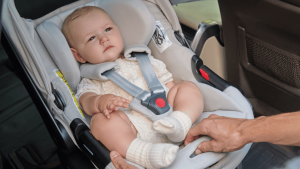
Functional anatomy of posture in children
Posture in children constitutes a fundamental element for correct musculoskeletal and respiratory development. The spine in pediatric age is characterized by dynamic physiological curves – cervical lordosis, thoracic kyphosis, and lumbar lordosis – which evolve progressively during growth and allow for optimal load distribution, trunk support, and coordination of breathing.
This intrinsic plasticity offers the opportunity to favor harmonic postural patterns through correct positions and adequate supports.
Development of Vertebral Curves
- Cervical lordosis: becomes consolidated in the first months of life, facilitating head control and visual interaction with the surrounding environment. A neutral head posture optimizes respiratory function and stability of the cervical spine.
- Thoracic kyphosis: physiological dorsal curve that allows for lung expansion and chest flexibility. A correct inclination of the trunk favors the maintenance of a functional rib cage and efficient diaphragmatic breathing.
- Lumbar lordosis: lumbar curve that supports pelvic stability and postural balance. Adequate lumbar support promotes correct alignment of the pelvis, optimizing the activity of the stabilizing muscles and global posture.
Benefits of correct posture in car seats
Adopting ergonomic and well-supported postures in car seats offers numerous advantages for the child’s development:
- Optimization of respiratory function: maintaining neutral alignment of the head and trunk allows for maximum thoracic expansion and effective lung ventilation.
- Harmonic development of postural muscles: adequate support favors balanced activation of the cervical, dorsal, and lumbar muscles, improving trunk stability and motor coordination.
- Pelvic and lumbar stability: correct positioning of the pelvis and lumbar support promotes the strengthening of the deep core muscles, supporting functional balance and spinal alignment.
- Scapular alignment: ergonomic posture contributes to keeping the shoulders in a natural position, favoring the opening of the chest, breathing capacity, and freedom of movement of the upper limbs.
Implications for health and development
In children, breathing is predominantly diaphragmatic, with a fundamental role of the diaphragm muscle in thoraco-abdominal ventilation, and posture directly influences respiratory efficiency, muscular coordination and the development of lung capacity.
In infants and children in early childhood:
- Breathing is mainly diaphragmatic, with the diaphragm performing the primary function of ventilation.
- The rib cage is flexible and more vertical than in adults, allowing for high compliance but requiring correct alignment to fully exploit lung volume.
- The supine posture favors a balanced activation of the diaphragm, while a sitting posture in flexion can reduce thoracic excursion and increase the compensatory respiratory rate.
With age and musculoskeletal maturation:
- A gradual transition towards more thoracic breathing is observed, with greater participation of the intercostal and trunk-stabilizing muscles.
- The upright and correctly supported posture allows for a uniform distribution of respiratory loads between the diaphragm, abdominal, and thoracic muscles, increasing vital capacity and ventilatory efficiency.
Effects of the sitting position on the chest and lungs
The different postural configurations assumed in the car seat can differently influence thoracic dynamics and respiratory function:
- Neutral seating with lumbar and cervical support: allows full chest expansion, reduces muscle tension, and keeps the diaphragmatic function fully efficient.
- Controlled inclination of the car seat: in infants, a car seat recline of around 30–45° is generally recommended, which helps keep the head aligned with the trunk and reduces the risk of excessive neck flexion with possible airway obstruction. This position favors the maintenance of airway patency and regular breathing during transport.
- Flexed seat or trunk leaning forward: can reduce chest excursion and limit tidal volume, leading to an increase in respiratory rate to maintain adequate oxygen supply.
- Upright posture: with adequate supports, favors rib mobility and greater inspiratory capacity, supporting the harmonic development of the rib cage and improving long-term lung function.
An ergonomic positioning during transport allows children to maintain effective and stable breathing patterns, stimulates the correct development of the thoracic and diaphragmatic muscles, and supports the maturation of neuromuscular trunk control. In older children, correct postural habits help preserve lung capacity, improve ventilatory efficiency, and promote greater resistance to muscle fatigue during daily activities.
Duration of travel and strategies for postural comfort in children
During car travel, especially in infants and young children, it is important to also consider the time spent in the car seat. Although these devices are designed to guarantee maximum safety during transport, prolonged stay in a sitting position can lead to periods of immobility and a limited possibility to spontaneously change posture.
For this reason, the main pediatric organizations recommend, during longer journeys, to provide periodic stops that allow the child to be temporarily removed from the car seat. These breaks allow for changing position, reducing immobility time, and improving general comfort during the journey.
In newborns and infants, who present still immature cervical control, it is particularly important to monitor head position during travel. The head should remain aligned with the trunk, avoiding forward flexion which can occur especially during sleep. It is also advisable to periodically check that the nose and mouth remain clear and that the car seat belts are correctly positioned.
As the child grows and postural control progressively develops, the position in the car seat gradually becomes more vertical. In all age groups, however, it is fundamental that the child is adequately supported by the car seat, without excessive lateral tilts of the trunk, and that the restraint system is correctly adjusted.
Practical recommendations during travel
- Schedule stops on longer journeys, to allow the child to be taken out of the car seat and change position.
- Periodically check head position in infants, especially during sleep.
- Ensure that the belts are correctly adjusted and snug against the body, according to the manufacturer’s instructions.
- Progressively adapt the car seat to the child’s growth: as the child grows, it is appropriate to check that the height of the headrest and the belts is adjusted to keep the restraint system snug against the body and that the child is stably supported in the car seat backrest.
