
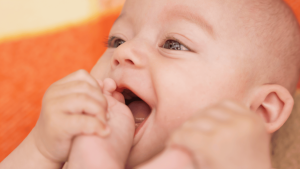
The Oral Feet Exploratory Behavior consists of the insertion of the feet into the oral cavity and is a phenomenon observable in newborns and infants. This behavior typically emerges between 4 and 7 months of age, a period in which the child acquires greater joint flexibility at the level of the hips and pelvis, together with a progressive control of the abdominal and dorsal muscles, necessary to bring the extremities to the oral cavity. In infants, this behavior tends to persist until 10-12 months, progressively decreasing as global motor skills improve and the ability to manipulate external objects increases.
There is evidence that similar phenomena can already be observed in intrauterine life, between the 20th and 30th week of gestation, when the fetus manifests flexion movements of the lower limbs, occasionally bringing the hands or feet toward the face, in addition to performing sucking movements, stretching, trunk rotations, and fetal breathing movements. These early motor patterns constitute the basis for subsequent neuromotor coordination and for the birth of oral exploratory behaviors, including feet in the mouth.
Psychodynamic interpretations and construction of the body schema
From a behavioral point of view, the infant not only brings their feet to the mouth but often smells or licks them, focusing in particular on the big toe (hallux). This toe is the most easily reachable and provides intense proprioceptive stimulation, thanks to its size and rigidity, which allows the infant to explore pressure and tactile contact with precision. Some authors emphasize that this behavior is not accidental: according to Freud, the mouth constitutes the first zone of gratification and sensory discovery; oralization of the feet allows the child to exercise body curiosity and self-regulation, experiencing tactile and sensory pleasure in a safe context.
Other authors, such as Mahler and Piaget, have interpreted these behaviors as part of the progressive construction of the body schema, in which the child integrates tactile, proprioceptive, and motor information to understand the relationships between body parts.
Neuro-sensory dimension and self-regulation
From a neuro-sensory point of view, mouthing of the feet is closely related to a mechanism of self-soothing and self-regulation. Oralization allows the infant to modulate tactile and proprioceptive stimuli, favoring the stabilization of muscle tone and the regulation of the autonomic nervous system. This behavior integrates sensory perception and motor coordination, providing positive feedback that contributes to maintaining a state of calm and reducing internal tension.
Neonatal sleep architecture and physiological significance
From a biomechanical point of view, the newborn’s ability to bring their feet to their mouth depends on a combination of factors: flexibility of the hip joints, strength of the abdominal and dorsal muscles, postural control and eye-hand/foot coordination. The act of mouthing the feet integrates proprioceptive stimulation and emotional modulation, constituting a functional behavior for internal regulation and overall motor development.
This gesture promotes the development of proprioceptive awareness and body perception, significantly improving the joint mobility of the hips, the pelvis, and the spinal column, with particular benefit for the coxo-femoral joints, the sacrum, and the paravertebral muscles. The flexion, adduction, and rotation of the lower limbs during the act of bringing the feet to the mouth contribute to increasing the elasticity and functionality of the periarticular muscle groups, including flexors, extensors, and abductors of the hip, in addition to improving trunk stability.
Postural development and integration of muscle chains
Dal punto di vista dello sviluppo posturale, l’Oral Feet Exploratory Behavior stimola il controllo del tronco e del bacino, favorendo l’attivazione coordinata della muscolatura addominale profonda, dei muscoli lombari e dei glutei. Questo promuove una sinergia tonica tra catene muscolari anteriori e posteriori, rafforzando il tono corporeo (TC) e migliorando l’equilibrio statico e dinamico. L’atto di portare i piedi alla bocca richiede inoltre una modulazione precisa della forza muscolare e del reclutamento motorio, integrando feedback propriocettivi, vestibolari e tattili, che contribuiscono allo sviluppo di pattern motori complessi e bilaterali.
Neuromotor coordination and functional maturation
In terms of neuromotor coordination, the behavior facilitates sensory integration between body perception, perception of space, and postural control, allowing the newborn to actively explore their motor skills and improve the stability of the spinal column, the orientation of the pelvis, and the alignment of the hips. This practice also supports the maturation of automatic postural reflexes and fine and gross motor skills, fundamental for progressive motor autonomy and for the harmonious development of the musculoskeletal system during growth.
Body awareness and body schema development
The Oral Feet Exploratory Behavior favors the early development of body perception and the body schema (body schema), allowing the child to understand that the feet are integral parts of their own organism. Bringing the feet to the mouth simultaneously stimulates the proprioceptive, vestibular, and tactile systems, providing continuous feedback on the position of the limbs in space and on the relationship between the trunk, pelvis, and lower limbs.
This direct sensory experience contributes to the maturation of spatial awareness, improving the ability to orient the body in three-dimensional space and to modulate the muscular strength necessary for postural control. The combination of flexion, adduction, and rotation of the lower limbs develops the joint elasticity of the hips and the mobility of the pelvis, while the coordinated activation of the abdominal, dorsal, and gluteal muscles strengthens the body tone (BT) and promotes trunk stability.
In motor terms, this behavior supports neuromotor integration, allowing the child to synchronize bilateral movements and to perfect fine and gross coordination. Furthermore, the experience of bringing the feet to the mouth contributes to the formation of complex motor patterns, the regulation of muscle tone, and the development of automatic postural reflexes, providing a solid base for subsequent motor skills, such as rolling, autonomous sitting, and walking.
Oral Feet Exploratory Behavior constitutes a critical moment for the construction of the body schema, sensory modulation, and postural maturation, integrating perception, movement, and self-regulation in a functional dynamic for the global development of the newborn.
