
The umbilical cord represents the main fetoplacental vascular connection during gestation, allowing the blood transfer of oxygen, nutrients, and metabolites between the maternal and fetal compartments through a system of three vessels: one umbilical vein and two umbilical arteries. The umbilical vein, of larger caliber, carries oxygen-rich blood and anabolic substrates from the placenta to the fetus, while the umbilical arteries transport oxygen-poor blood containing waste products back to the placenta for maternal elimination.
Postnatal physiological changes of the cord
Once its functions have been fulfilled and birth has occurred, with the establishment of autonomous respiration and enteral nutrition, and in the absence of complications, the umbilical cord undergoes a mummification process, as it no longer serves any function.
Umbilical cord clamping: recommendations and benefits
Under standard hospital delivery conditions, delayed cord clamping is recommended, ideally not earlier than ≥60 seconds after birth for term and preterm newborns of ≥37 weeks’ gestation who are not in emergency conditions. This practice is associated with improved transient fetal blood volume and optimization of neonatal iron stores, without a documented increase in significant clinical complications (combined WHO/AAP/AHA guidelines).
Recommendations from the Italian Society of Neonatology (SIN) and international organizations (WHO) since 2011 promote delayed cord clamping (DCC) for healthy newborns, waiting at least 1–3 minutes after birth (or until the cord stops pulsating), in order to transfer more fetal blood, improve iron reserves, and reduce the risk of anemia and the need for transfusions, while still allowing for initial resuscitation maneuvers if necessary, such as drying and stimulation.
Impact of delayed cord clamping on iron stores and neurological development
Breast milk alone is not able to provide newborns with all the iron they require; therefore, they must rely on iron stored in their bodies. The additional blood resulting from delayed cord clamping provides newborns with an extra amount of iron, ensuring sufficient reserves for rapid growth and conferring several long-term benefits. More recent studies on cord clamping have shown that delaying clamping increases the amount of myelin in the brain, a white fatty substance that coats neural connections. Myelin insulates nerve connections and plays a key role in proper brain function, as adequate myelination leads to more efficient brain development.
Formation and characteristics of the umbilical stump
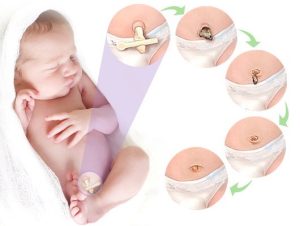
After clamping and surgical section of the umbilical cord using sterile instruments, an umbilical stump remains: a portion of fibrovascular tissue surrounded by Wharton’s jelly, which undergoes a physiological process of drying and mummification, typically lasting 7 to 14 days, with individual variability. During this period, progressive structural changes occur, culminating in the spontaneous detachment of the stump and formation of the umbilical scar.
WHO guidelines for umbilical cord stump care
The World Health Organization (WHO) postnatal care guidelines (updated in 2017) recommend an umbilical cord care strategy based on hygiene and dryness (“dry cord care”) in settings with high healthcare capacity, where unhygienic traditional practices are not prevalent. Routine application of 4% topical chlorhexidine to the stump is indicated only in specific high-risk settings with elevated neonatal mortality related to umbilical sepsis.
Clinical management of the stump in the Italian and European context
In the Italian and European pediatric clinical context, umbilical stump care focuses on the prevention of skin inflammation and infection (omphalitis) through daily monitoring, maintenance of a clean and dry site, and observation for signs of redness, edema, or purulent discharge. Cleansing should be performed using saline solution or water and mild soap, gently dabbing to remove debris and physiological blood residues; thorough drying of the stump base and surrounding skin is essential to prevent epidermal maceration. If the diaper interferes with air exposure, its upper edge should be folded down to keep the umbilical area as well aerated as possible.
Time to stump separation and hygiene recommendations
Spontaneous detachment of the stump occurs in most newborns between 7 and 14 days of life, but may extend up to 21 days in some cases without pathological significance. During this period, it is recommended to avoid immersion in water (tub bathing) until complete spontaneous separation of the stump and full healing of the umbilical wound. Local washing with lukewarm water is acceptable, provided the area is dried immediately with sterile gauze (Figure 1).
Neonatal and pediatric guidelines emphasize the need to wash hands thoroughly before any manipulation of the stump in order to reduce the risk of bacterial colonization and possible omphalitis, which may present with marked redness, purulent discharge, fever, unpleasant odor, or local edema, and which requires prompt pediatric evaluation. The use of dry sterile gauze and, when necessary, allergenic-free protective dressings, is consistent with clinical recommendations to optimize healing and prevent contamination.
In summary, an evidence-based approach to umbilical cord care in the healthy newborn combines principles of asepsis, gentle cleansing, maintenance of dryness, and daily clinical observation, with the aim of promoting spontaneous and complete separation of the stump, preventing local infections, and fostering optimal healing of the umbilical wound in accordance with international guidelines.
Clinical management of the umbilical stump in the newborn
The umbilical stump represents the residual portion of the fetoplacental connection and requires careful management during the period of spontaneous separation, which in term newborns occurs on average between 7 and 14 days of life, with individual variability up to 21 days. Umbilical stump care is based on principles of asepsis, prevention of skin maceration, and promotion of optimal healing.

Cleansing and hygiene
Daily cleansing should be performed using sterile saline solution or lukewarm water and mild soap, avoiding aggressive detergents or alcohol-based products that may alter the physiological pH and damage the neonatal stratum corneum. Cleansing should be limited to the base of the stump and surrounding skin, gently removing blood residues or saline; small amounts of blood or clear exudate do not require pharmacological intervention.
Drying and air exposure
After cleansing, the stump and surrounding skin should be gently patted dry with sterile gauze, without rubbing, to avoid microtrauma and epidermal irritation. Maximizing air exposure is recommended: when possible, the infant’s diaper should be folded below the stump to prevent direct contact with urine or feces, thereby reducing the risk of bacterial colonization and delaying the physiological process of drying and mummification.
Dressing and protection
In clinical settings, a dry sterile gauze may be applied around the stump, secured with an umbilical band or protective mesh. The dressing should not create a warm and moist environment, which may slow stump separation and promote microbial proliferation. The use of antibiotic ointments or creams is indicated only in the presence of clinical signs of infection or according to pediatric prescription, in accordance with WHO and ISS guidelines.
Clinical monitoring and surveillance
Daily assessment of the stump should include observation for:
- Perilesional erythema (intense or progressive redness)
- Local edema or swelling
- Purulent or malodorous discharge
- Excessive bleeding
The presence of one or more of these signs requires immediate pediatric evaluation, as they may indicate omphalitis or other infectious complications.
Bathing and neonatal body hygiene
Complete immersion bathing should be avoided until stump separation; however, sponge bathing with lukewarm water is permitted, taking care not to saturate the stump. After washing, the area should be thoroughly dried with sterile gauze, keeping it dry.
Management of accidental contamination
In the event of contamination with urine or feces, the following steps are required:
- Gently wash the stump and surrounding skin with lukewarm water and mild soap.
- Pat dry thoroughly with sterile gauze.
- Apply a clean, dry gauze, ensuring air exposure.
Evidence-based approach and guidelines
WHO guidelines (2017), the American Academy of Pediatrics (AAP, 2020), and ISS/SIMPeD recommendations endorse a “dry cord care” approach in healthy newborns, emphasizing:
- Thorough hand washing before any contact with the stump.
- Avoidance of unnecessary dressings and chemical products in low-risk settings.
- Daily clinical monitoring for early detection of infection.
- Maximizing air exposure to accelerate stump separation.
This approach minimizes the risk of omphalitis, promotes physiological spontaneous separation, and supports the formation of a healthy umbilical scar.
