
Neonatal skin represents an organ undergoing functional maturation, whose complex histological and biochemical architecture is incompletely developed at birth. This structural immaturity results in reduced efficiency of the cutaneous barrier function during the first months of life, rendering the epidermal surface particularly susceptible to environmental, mechanical, and chemical insults. This state of physiological vulnerability exposes the newborn to a significantly increased risk of superficial skin alterations, microlesions, and irritant dermatitis—phenomena that are widely documented and recognized as clinically relevant by leading international dermatological and neonatological scientific societies.
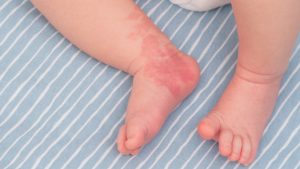
Epidermal Characteristics
According to the joint guidelines of the American Academy of Pediatrics (AAP), the European Academy of Dermatology and Venereology (EADV), and the British Association of Dermatologists, neonatal epidermis is characterized by:
- a thinner and less compact stratum corneum;
- a reduced concentration of epidermal lipids organized into functional lamellae;
- incomplete intercorneocyte cohesion.
These factors contribute to an unstable and permeable skin barrier. The cutaneous pH, initially close to neutrality, undergoes a progressive acidification over the first 4–6 weeks of life—a physiological process known as acid mantle development. This process is essential for regulating stratum corneum enzymatic activity, promoting maturation of innate cutaneous defenses, and stabilizing the resident microbiota.
At the dermal level, a lower density of mature collagen fibers, reduced extracellular matrix organization, and more superficial vascularization are observed. These characteristics contribute to increased skin permeability and elevated transepidermal water loss (TEWL), a parameter that is significantly higher in newborns than in older infants and adults, as highlighted by the recommendations of the International Society of Pediatric Dermatology. Increased TEWL is a sensitive indicator of barrier immaturity and a predisposing factor for the development of xerosis and skin irritation.
Epidemiology of Neonatal Skin Alterations
Epidemiological data reported in the literature indicate that:
- up to 45–60% of newborns develop at least one transient skin alteration within the first month of life;
- irritant contact dermatitis, particularly in the diaper area, has an estimated prevalence of 25–50% during the first six months;
- superficial excoriations and traumatic microabrasions affect approximately 30–40% of newborns, with peak incidence during the first 14 days of life;
- neonatal skin xerosis shows a variable incidence ranging from 20 to 40%, especially in environments with low relative humidity or during winter months.
These findings, reported in the AAP–EADV consensus guidelines, clearly emphasize the need to implement structured and standardized preventive strategies from hospital discharge onward to support appropriate extrauterine skin adaptation.
Cutaneous Microlesions
Neonatal cutaneous microlesions encompass a wide spectrum of manifestations, including excoriations, epidermal fissures, maceration of intertriginous areas, and iatrogenic microabrasions. Although generally superficial and self-limiting, these disruptions of the skin barrier can activate a local inflammatory cascade mediated by pro-inflammatory cytokines and increase the risk of microbial colonization.
In particular, an increased susceptibility to colonization by Staphylococcus aureus and Candida spp. has been documented, as highlighted in World Health Organization (WHO) guidelines on neonatal infection prevention.
Practices to Avoid in Neonatal Skin Care
Joint recommendations from the WHO, AAP, and NICE (UK) explicitly advise against practices that may be harmful to immature neonatal skin, including:
- the use of alcohol-based disinfectants, high-concentration chlorhexidine, and iodopovidone on intact skin;
- alkaline, antibacterial, or fragranced cleansers;
- prolonged or excessively frequent bathing during the first months of life;
- vigorous mechanical friction during drying or diaper changes.
These interventions are associated with a documented increase in irritant dermatitis incidence and further impairment of epidermal barrier function.
Evidence-Based Dermoprotective Strategies
European and North American pediatric dermatology guidelines converge in recommending a minimalist, physiological approach that respects skin maturation, based on:
- gentle cleansing with lukewarm water and pH 5.5–6 syndet cleansers, used on a non-daily basis;
- early, regular, and continuous application of emollients formulated with ceramides, cholesterol, and long-chain fatty acids to mimic the physiological lipid composition of the stratum corneum;
- targeted use of barrier pastes in areas most exposed to moisture, friction, and fecal contamination;
- selection of formulations free from fragrances, dyes, and preservatives with high sensitizing potential.
Randomized controlled trials have demonstrated that early emollient use can reduce the incidence of xerosis and irritant dermatitis by up to 30–50% during the first months of life, confirming the central role of preventive dermoprotection.
Daily Prevention of Skin Lesions
According to recommendations from the AAP and the European Society of Neonatology, daily prevention of skin lesions also includes:
- regular trimming of nails to limit self-inflicted excoriations;
- exclusive use of natural, soft, and breathable fabrics in direct contact with the skin;
- maintenance of a controlled home microclimate, with relative humidity maintained between 40 and 60%;
- systematic daily skin observation during diaper changes and bathing to enable early detection of any signs of alteration.
Due to its unique structural and biochemical characteristics, neonatal skin exhibits a physiological vulnerability that is extensively documented by epidemiological data and acknowledged by major international guidelines. The timely and informed adoption of evidence-based dermoprotective strategies allows for a significant reduction in the incidence of cutaneous microlesions and irritant dermatitis, promoting a harmonious and optimal process of skin adaptation during the neonatal period and the first months of life.
