
The sun protection factor (Sun Protection Factor, SPF) represents the main parameter used to quantify the efficacy of a photoprotective product against ultraviolet radiation. It is defined as the ratio between the minimal erythemal dose (Minimal Erythema Dose, MED) on skin protected by the product and the MED on unprotected skin.
The minimal erythemal dose corresponds to the amount of energy required to cause the appearance of the first clinically evident skin erythema after exposure to UV radiation. Since sunburn is mainly determined by the UVB component, SPF mainly represents a measure of protection against UVB and does not fully describe the product’s ability to screen UVA.
This aspect takes on particular relevance in the newborn and infant, since UVA radiation, especially the UVA1 (340–400 nm) component, has a greater capacity for skin penetration and can reach the deep layers of immature skin, inducing oxidative stress, DNA alterations, extracellular matrix damage, and modulation of the cutaneous immune response. For this reason, a product intended for early childhood must guarantee broad-spectrum protection, encompassing both UVB and UVA, with a balanced ratio between the two protection systems.
According to the recommendations of the European Commission, UVA protection must be at least equal to one-third of the declared SPF value. Therefore, a product with a high SPF must necessarily also possess an adequate level of UVA protection.

Interpretation of SPF in products intended for infants
The commonly used classification distinguishes photoprotective products into:
- low protection: SPF 6–10;
- medium protection: SPF 15–25;
- high protection: SPF 30–50;
- very high protection: SPF 50+.
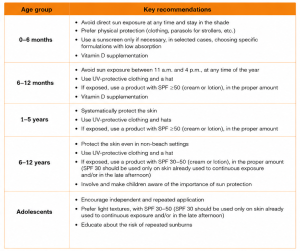
In the newborn and infant, when the use of a topical photoprotector is indicated (generally after 6 months of life and only on areas not protected by clothing), the choice must be oriented exclusively towards products with SPF 50+, characterized by high UVA and UVB protection.
It is essential to emphasize that no sunscreen product, including SPF 50+, guarantees total shielding from ultraviolet radiation. A high SPF should therefore not generate a false sense of security, leading to prolonged sun exposure for the child.
UVA protection: importance in the first year of life
The evaluation of UVA protection is particularly important in the first months of life, as infant skin has:
- reduced epidermal and dermal thickness;
- lower functional melanin content;
- antioxidant systems still maturing;
- reduced capacity for cutaneous immunological response.
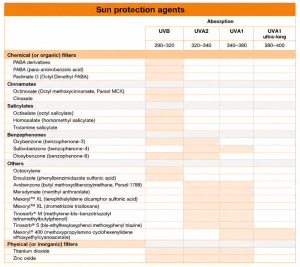
The most effective photoprotective products must therefore protect against both UVA2 (320–340 nm) and UVA1 (340–400 nm). This latter component is particularly relevant as it represents the predominant share of the UV radiation we are exposed to daily and contributes significantly to chronic skin damage.
In infants, it is therefore preferable to choose products with an explicit indication of broad-spectrum UVA/UVB protection, with particular attention to the presence of filter systems capable of guaranteeing effective coverage even against long UVA rays.
Water resistance and photostability
Water resistance
Water resistance represents an important feature in children, even if in the first year of life, prolonged exposure in water should still be avoided for thermal and environmental safety reasons.
A product defined as water resistant maintains at least 50% of the declared protection factor after specific standardized water immersion tests.
The term waterproof, used in some countries, is no longer generally accepted in European regulations since no product is completely waterproof; even water-resistant products require reapplication after immersion, sweating, or towel drying.
Photostability
The photostability indicates the ability of the filtering system to maintain its effectiveness unaltered during sun exposure.
In the newborn and infant, this parameter is particularly important because immature skin is more vulnerable to the formation of reactive oxygen species generated by the degradation of UV filters.
Therefore, formulations characterized by the following are to be preferred:
- high light stability;
- persistent UVA/UVB protection;
- reduced presence of potentially irritating components.
Formulation and cosmetic characteristics of products for infants
The formulation represents a fundamental element in the choice of a pediatric photoprotective product, since it influences skin tolerance, ease of application, and the quantity actually used.
In the first year of life, the following are preferable:
- easily spreadable creams or fluid emulsions;
- fragrance-free formulations;
- hypoallergenic and dermatologically tested products;
- non-occlusive textures compatible with the infant’s sensitive skin.
Spray formulations, although practical in older children, are generally not recommended in the first years of life due to the possible risk of accidental inhalation during application, the difficulty of ensuring uniform distribution, and the risk of applying insufficient quantities of product.
Similarly, transparent or fast-absorbing products can lead to uneven application and a reduction in real efficacy compared to the declared SPF value.
Skin phototype and vulnerability to ultraviolet radiation in the first year of life
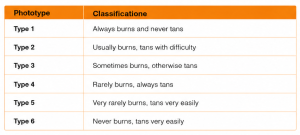
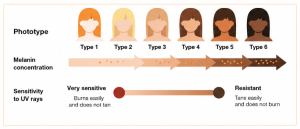
The evaluation of skin phototype represents a useful element in defining individual susceptibility to ultraviolet radiation, but in the newborn and infant, it cannot be considered the only parameter for determining the level of photoprotection needed. The most commonly used classification is that of Fitzpatrick, which divides skin into six phototypes (I–VI) based on the ability to develop erythema and tan after sun exposure.
- Children with fair phototypes (I–II), characterized by very fair skin, blonde or red hair, light eyes, and poor capacity for melanogenesis, present a greater susceptibility to acute sunburn and an increased risk of UV-induced damage over the course of their lives.
- In intermediate phototypes (III–IV), the ability to produce melanin provides partial natural protection
- In darker phototypes (V–VI) the greater amount of epidermal melanin reduces the risk of erythema and sunburn.
However, during the first year of life, physiological melanin protection is not yet fully developed. Even in children with darker phototypes, melanogenesis and the distribution of melanosomes present characteristics different from those of adults, making infant skin more vulnerable to the biological effects of ultraviolet radiation. Therefore, the risk of cellular damage, oxidative stress, and UV-induced immunological alterations is not completely eliminated by greater skin pigmentation.
For this reason, photoprotection strategies in the newborn and infant must be applied regardless of phototype. In children with phototypes I–III, it is particularly important to prevent erythema and sunburn, while in children with phototypes IV–VI, protection remains essential to limit cumulative UV damage, photoimmunosuppression, and the long-term risk of photo-induced skin conditions.
In the first year of life, the guiding principle should therefore not be the modulation of protection based exclusively on phototype, but the application of a universal approach based on reducing exposure, physical protection, and, when necessary, the prudent use of photoprotectors pediatric broad-spectrum.
Conclusion
In summary, photoprotection in the first year of life must be based primarily on the prevention of UV exposure. In the first six months, direct sun should be avoided, prioritizing shade, protective clothing, and hats. After six months, when exposure is unavoidable, a pediatric broad-spectrum SPF 50+ photoprotector, preferably with mineral filters, represents a complementary measure to physical barriers and not a substitute for them. Promoting these habits from the first months of life means investing in skin health in the following years, contributing to reducing cumulative actinic damage and the risk of photo-induced skin pathologies.
