
When designing living spaces for families, attention is often focused primarily on functional aspects such as rest, nutrition, and the organization of the home. However, numerous studies in the fields of environmental psychology and neuroarchitecture have shown that the home environment significantly influences the emotional, relational, and psychological well-being of both adults and newborns.
Within this context, Feng Shui, an ancient Chinese discipline whose name can be translated as “wind” and “water,” offers a valuable perspective. Feng Shui proposes a systemic interpretation of the environment, viewing it not merely as a physical setting but as an active element in the regulation of psychophysical and relational well-being.
Origins and Meaning of Feng Shui
Feng Shui has its roots in ancient China more than 5,000 years ago and originated as a system for observing the relationship between human beings, nature, and the built environment. Traditionally, this discipline evaluates the quality of living spaces according to their ability to promote health, emotional stability, and prosperity.
From a contemporary perspective, Feng Shui can be understood as a conceptual bridge between architecture, neuroscience, and environmental psychology, offering valuable insights for designing spaces that foster balance, security, and quality of life, particularly during the sensitive stages of early childhood development.
Environment and Well-being: A Shared Perspective Across Cultures
Concern for the influence of the environment on human well-being is not exclusive to Chinese culture. Other ancient civilizations, including the Romans, also recognized the importance of the surrounding environment. The concept of the Genius Loci described the unique “spirit” or “quality” of a place, believed to influence the lives and well-being of its inhabitants.
The key difference is that, whereas many Western traditions became fragmented or disappeared over time, Chinese culture has preserved and continuously transmitted this body of knowledge, allowing Feng Shui to evolve and to be reinterpreted in light of modern scientific understanding.
The Subjective Perception of Space
It is a common experience to perceive different emotional states in different environments: some rooms promote relaxation and a sense of security, while others encourage alertness or concentration. Feng Shui interprets these phenomena through the concept of the energetic quality of space, whereas environmental neuroscience refers to sensory stimuli, spatial configurations, and cognitive load.
Simple interventions—such as rearranging furniture, introducing natural elements, or reorganizing spaces dedicated to the child—can improve the quality of the living environment, promoting a more stable and emotionally balanced atmosphere.
Fundamental Principles of Feng Shui
Feng Shui is based on two main theoretical pillars:
- The Theory of Yin and Yang, which describes the dynamic balance between complementary polarities such as activity and rest, light and darkness, stimulation and relaxation.
- The Theory of the Five Elements (Wood, Fire, Earth, Metal, and Water), which is used to interpret the symbolic and functional qualities of environments.
Within the home, the goal is to create a harmonious distribution of spaces that supports the developmental, emotional, and relational needs of the family, with particular attention to the newborn.
The Home as a Supportive Environment for Development
A home responds not only to material needs—such as nutrition, sleep, and protection—but also to psychological and relational needs, including security, a sense of belonging, communication, emotional regulation, and future planning.
Thoughtful interior design can help to:
- promote concentration and productivity;
- support parent–child communication;
- improve sleep quality;
- strengthen the couple’s relationship;
- foster mental and emotional organization;
- encourage family interaction and shared experiences.
These objectives are consistent both with the principles of Feng Shui and with the findings of environmental psychology, which demonstrate that natural light, order, appropriate color choices, and clearly defined spaces positively influence well-being and the quality of interpersonal relationships.
The Child’s Bedroom: A Space for Security and Restoration
In Feng Shui, the bedroom is considered the primary space for restoring energy. For newborns and young children, it plays an even more important role, as it contributes to the development of a sense of primary security.
A visually uncluttered environment, with soft colors, gentle lighting, and natural materials, promotes:
- deep, restorative sleep;
- emotional regulation;
- a sense of protection;
- the strengthening of the emotional bond between the child and the parents.
Bedroom and Crib Placement
According to Feng Shui principles, the child’s bedroom should ideally be located in a quiet, protected area of the home. An east-facing orientation has traditionally been associated with growth and renewal, while modern science recognizes morning natural light as an important regulator of the circadian rhythm.
Regarding the bed:
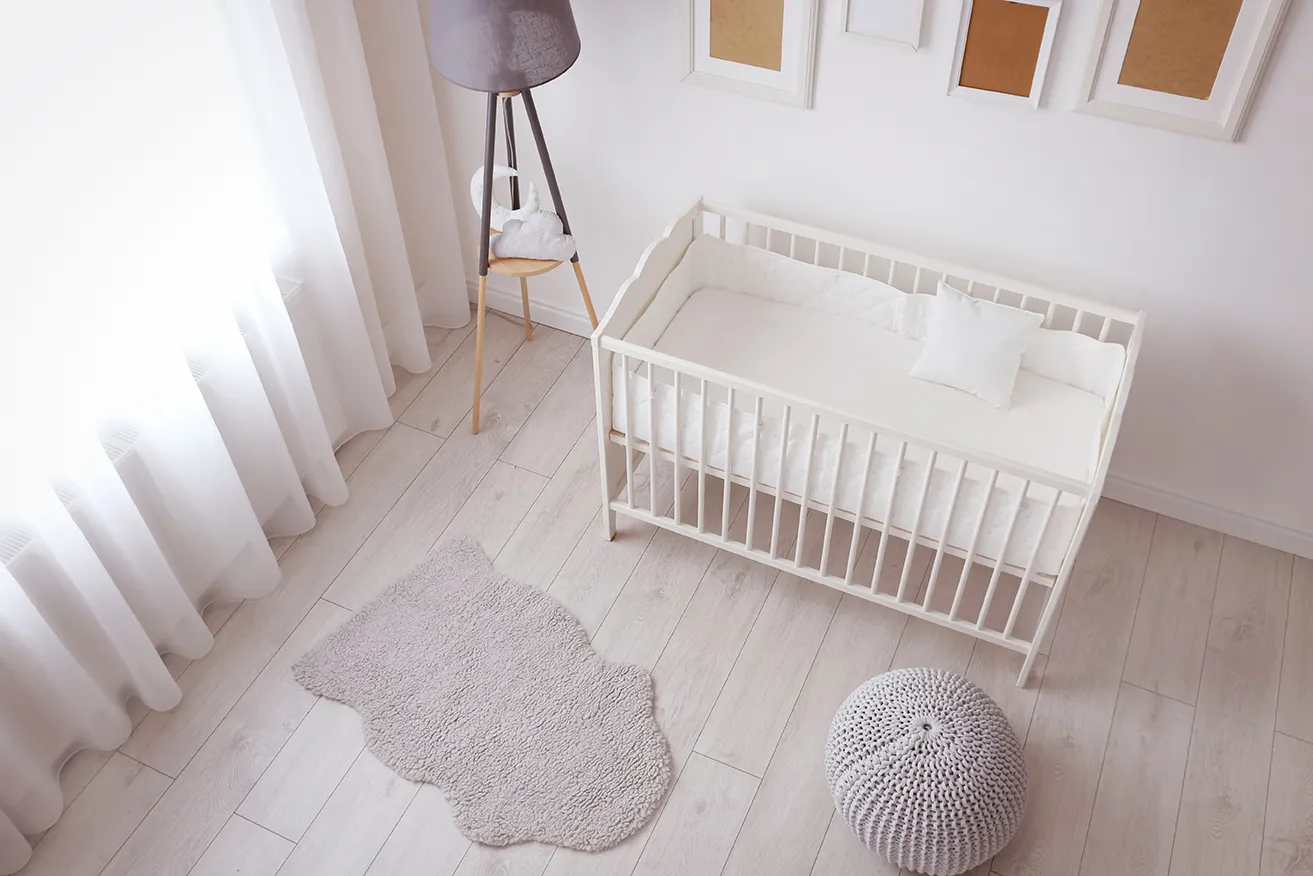
- it is preferable to position it at some distance from the bedroom door;
- avoid placing it directly beneath windows;
- keep the surrounding area uncluttered and well organized;
- avoid storing objects underneath the crib, promoting a greater sense of lightness and stability.
From a modern perspective, these recommendations can be interpreted as practical strategies for minimizing distracting stimuli and creating a predictable, reassuring environment.
Orientation and the Child’s Individuality
Recommendations concerning cardinal directions (head facing north, east, south, etc.) belong to the symbolic tradition of Feng Shui. Within a contemporary framework, these suggestions should be interpreted flexibly, taking into account each child’s temperament, sensitivity, and individual needs.
There is no universally ideal orientation; careful observation of the child’s individual well-being should always remain the primary criterion.
Materials and Environmental Safety
The choice of materials plays a fundamental role in the quality of a child’s environment.
Wood is particularly recommended because it:
- is a natural, warm material;
- contributes to a perception of stability and comfort;
- absorbs humidity, helping to improve indoor air quality;
- provides matte, non-reflective surfaces that are less stimulating from a sensory perspective.
Furniture with rounded shapes, light colors, and non-glossy finishes is recommended. Conversely, the excessive use of metal is generally discouraged, primarily for reasons related to comfort, safety, and sensory perception rather than strictly energetic considerations.
Qi, Pregnancy, and the Mother–Child Relationship
In Traditional Chinese Medicine, Qi (Chi) represents the vital energy that sustains the body’s physiological functions. During pregnancy, the mother’s physical and emotional well-being is considered fundamental to fetal development.
From a scientific perspective, this concept can be related to:
- the mother’s emotional state;
- stress regulation;
- prenatal bonding;
- the influence of the environment on the neuroendocrine system.
Consequently, a harmonious home environment may indirectly support the well-being of the mother–child dyad.
An Important Clarification
During the 1970s, as Feng Shui spread throughout the Western world, it was often oversimplified and reduced to a collection of rigid rules or decorative objects lacking scientific foundation. It is important to distinguish these commercial interpretations from Feng Shui understood as a discipline concerned with the relationship between people and their environment.
From a scientific and pediatric perspective, Feng Shui should not be regarded as an esoteric practice, but rather as a cultural framework that can complement evidence-based environmental design and integrate with modern knowledge of child development and well-being.
Conclusion
Creating a harmonious environment for newborns and children means designing spaces that support security, emotional regulation, and healthy development. When critically reinterpreted and integrated with contemporary scientific knowledge, Feng Shui offers a valuable conceptual framework for helping families create a welcoming, balanced home that respects children’s developmental needs.
