
The first “swimmer” of our existence is not the newborn, but the fetus, which for about forty weeks develops immersed in the amniotic fluid inside the maternal womb. This environment represents the first human vital space and a unique condition of growth, in which the body is not subject to gravity and can move freely in all directions.
In this suspended dimension, the fetus does not swim in a voluntary sense, but lives a complete motor freedom made possible by the absence of gravitational load. Its movements, far from being random, constitute an essential component of early neuromotor development. During intrauterine life, in fact, the fetus performs extensions, flexions, rotations, and limb movements that not only accompany, but actively contribute to the formation of muscles and bones through continuous mechanical stimulations. Even the vestibular system, responsible for balance and the perception of movement, is organized thanks to these constant experiences. In this sense, the amniotic fluid is not simply a protective environment, but a dynamic matrix that allows the nervous system to structure itself through movement itself (Figure 1).
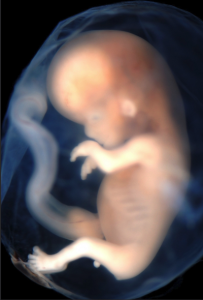
Amniotic fluid as a sensory and motor environment
The womb is indeed a highly specialized biological ecosystem, in which the amniotic fluid performs integrated functions of protection, growth, and regulation. It maintains a stable temperature, cushions external shocks, and allows that motor freedom indispensable for harmonious development. At the same time, it participates in maturation processes, such as the pulmonary one, through fetal respiratory movements that form a sort of physiological training for future respiratory function.
Alongside these physical functions, the intrauterine environment is also a deeply sensory context. The fetus is immersed in a network of filtered but constant stimuli, such as the rhythm of the mother’s heartbeat, respiratory movements, and the vibrations of the voice. These signals are not mere background noise, but structuring elements for the development of the nervous system, which begins to recognize and organize fundamental rhythmic patterns for future neurophysiological regulation. The womb thus becomes a true primary sensory matrix, in which the foundations of perception and emotional and bodily balance are laid.
Within this context, the concept of prenatal imprinting fits in, which should not be understood as conscious memory, but as a set of early neurobiological traces that influence the organism’s subsequent responses. The fetal nervous system develops in an environment characterized by containment, warmth, continuous contact, and fluidity, conditions that leave a form of implicit memory, deeply bodily and non-cognitive.
From the womb to neonatal aquaticity
After birth, the newborn passes from a liquid environment to an aerial environment and this involves an important physiological, respiratory, and sensory adaptation. The change concerns not only the function of breathing, but also the way the body perceives contact, weight, and temperature. In this transition, neonatal aquaticity should not be understood as an early teaching of swimming, but as a gradual experience of sensory familiarization with water.
In general, aquaticity courses can be introduced after the first neonatal period, approximately around three or four months of life, when the newborn has reached greater clinical stability and a better capacity for thermal and postural adaptation. In this phase, the goal is not motor learning, but emotional regulation, contact and sensory continuity with some characteristics of the intrauterine environment. The child does not “learn to swim”, but experiences an environment that can foster calm, containment, and relationship.
Safety, environment, and quality of the path
The choice of an aquaticity course should be based on some fundamental elements. It is important that the context is specifically structured for infants or early childhood, with instructors trained in the pediatric or psychomotor field and with a non-coercive approach centered on play and the relationship. The active presence of the parent in the water is an essential element, because it guarantees emotional safety and strengthens the attachment bond (Figure 2).
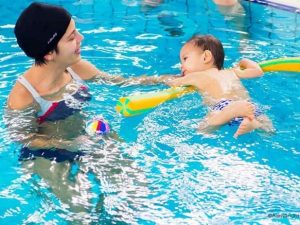
Another central aspect concerns the quality of the water and the environment. Swimming pools intended for infant aquaticity should maintain a water temperature generally between 32 and 34 degrees, to reduce thermal stress and promote muscle relaxation. The environment must be warm even out of the water, with appropriately heated changing rooms to avoid thermal shocks.
Hygiene represents a fundamental point. Facilities must guarantee a high standard of filtration and disinfection of the water, with regular checks of microbiological and chemical parameters. It is important that strict standards for cleaning the environments are respected and that children are not placed in the water in the presence of acute illnesses, especially respiratory or gastrointestinal, to protect both the individual and the group.
From the point of view of the type of activity, aquaticity courses can vary from gentler and sensory paths, centered on contact and assisted floating, to slightly more dynamic experiences that introduce autonomous movement in the water always in a playful form. In the first months, symbolic immersion activities, bodily contact, rocking, and gradual adaptation to water prevail, while with growth, more structured motor proposals increase.
Main indications in the pediatric field emphasize that these experiences are not medically necessary for the child’s development, but can favor psychomotor, relational, and sensory development if carried out safely, without force and respecting individual timing.
In this framework, water is not simply an environment for physical activity, but a relational and perceptive space that, if correctly proposed, can support emotional regulation, bodily confidence, and the quality of the relationship between parent and child.
Benefits of water in child development
The aquatic environment offers very specific stimulations that involve different aspects of child development. In water, the body is lighter and this facilitates spontaneous movement by reducing the load on the joints. The child can explore their body more freely and develop a greater body awareness.
From a sensory point of view, water simultaneously stimulates touch, proprioception, and the vestibular system, promoting better integration of bodily information. This multisensory experience contributes to the development of the central nervous system and the capacity for coordination.
On an emotional level, water can have a calming effect thanks to the sensation of containment and continuity with the uterine environment. The presence of the parent in the water also favors emotional co-regulation through physical contact, eye contact, and the synchronization of movements, strengthening the affective bond.
Finally, early aquatic experience can foster a positive familiarization with water, reducing any future fears and promoting a serene relationship with this element.
A biological continuum between womb and water
The transition from amniotic fluid to external water represents a sensory continuum. The fetus grows in water, the newborn is born in an aerial environment but retains an implicit bodily memory of that original condition. Water thus becomes an element that recalls the first life experience and, if proposed in a respectful and gradual way, can support the psychomotor and emotional development of the child through safety, relationship, and sensory continuity.
