
The nesting is a method devised by the psychiatrist Michel Lejoyeux that invites one to prepare with serenity for a new life path. It means learning to expect the best, to imagine it, to live it internally even before it happens: an attitude that helps to attract and build what we desire.
Engaging in nesting promotes well-being and increases happiness. The term “nesting”, in fact, derives from the English verb to nest, which means “to make a nest”, “to nestle” or, more simply, “to nest”: an image that recalls the idea of carefully and mindfully preparing the physical and emotional space for what is about to arrive.

In perinatology, the phenomenon of nesting indicates a complex set of organizational and motivational behaviors observed in advanced gestation and the first months of life, aimed at creating a safe, predictable, and structured environment.
Perinatal nesting and its purposes
The behaviors that characterize nesting represent the adaptive response of the dyad to the transition from intrauterine to extrauterine life and to the caregiving needs that are established immediately after birth. The nesting represents a multifactorial process that integrates sensory stimuli, neurophysiological regulation, environmental preparation, and caregiving modalities, constituting a fundamental component for perinatal adaptation.
The studies by Selma Fraiberg, psychoanalyst, and colleagues in 1980 and by Daniel N. Stern, psychiatrist, in 1995 highlighted the importance of adopting consistent routine measures and creating safe environments for the socio-emotional development of the newborn, while the research of Tiffany Field, an American psychologist, and Stephen Porges, an American neuroscientist, have provided key elements on the neurobiological mechanisms and the role of the autonomic system in the modulation of these behaviors.
During fetal life the fetus lives in a muffled intrauterine environment, characterized by reduced sensory stimulation, a stable thermostatic temperature, filtered sounds and perceptions of movement mediated mainly by proprioceptive and vestibular stimulation. This environment helps maintain a balanced autonomic tone, with a predominance of parasympathetic activity mediated by the vagus nerve, which promotes physiological stability and modulation of primary affective states.
The preparation of a muffled intrauterine environment is aided by stroking the abdomen as a safe and gentle way to interact with the fetus, creating a prenatal bond from the 17th-20th week, when the fetus begins to perceive caresses and vibrations through the amniotic fluid (Fig. 2).
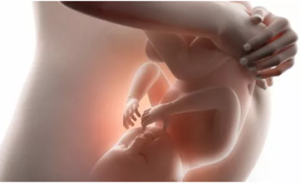
Birth involves a significant increase in multisensory stimuli, such as thermal variations, pressure, sounds and visual contact, which require the newborn a rapid and coordinated adaptation. Nesting emerges in this context as a natural strategy to organize the physical and social environment, modulate interactions with the caregiver and promote the newborn’s self-regulation, allowing a gradual and safe transition toward the complexity of extrauterine life.
Behavioral components and holding environment
The nesting includes behaviors such as the preparation of the physical space and the context in which the newborn will be found, the structuring of routine measures specific to consistent caregiving, the implementation of anticipatory behavioral responses by the expectant mother and the adoption of emotional regulation strategies, with the aim of creating a predictable and supportive environment.
Daniel Stern, an American psychiatrist, described how these behaviors contribute to the construction of a holding environment, a phenomenon that the British pediatrician and psychoanalyst Donald Woods Winnicott defined as a containment environment, a supportive environment (or maternal holding). The complex phenomenon of the “holding environment” facilitates the modulation of the emotional states of the newborn and promotes the development of a sense of security and coherence in the perception of the surrounding world.
In parallel, the observation of nesting provides an indicator of the neurophysiological state of the expectant mother and her ability to anticipate the newborn’s needs, highlighting the integration between cognitive, emotional and sensory processes.
Neurobiological bases and autonomic regulation
At the neurobiological level, nesting can be interpreted as a set of responses coordinated by autonomic, limbic and sensory nervous systems. Parasympathetic activation mediated by the vagus nerve allows for optimal regulation of muscle tone, heart rate and respiration, facilitating behaviors oriented toward the care and protection of the newborn.
Stephen Porges, an American neuroscientist, has highlighted how optimal vagal modulation promotes the ability to establish regulated social contacts, to respond to emotional stimuli in an appropriate way and to establish synergies between the expectant mother and the newborn that promote mutual emotional and physiological regulation.
Nesting and postnatal caregiving
Nesting is closely linked to postnatal caregiving methods. The adoption of routine measures that are consistent and predictable, such as regular and on-demand feeding, close physical contact, skin-to-skin contact and prompt response to the newborn’s cues contribute to the stabilization of cardio-respiratory rhythms, the development of regular sleep-wake patterns and the creation of synchrony between the caregiver and infant that supports autonomous regulation.
Longitudinal studies indicate that predictable environments and structured caregiving improve the newborn’s ability to modulate their responses to stress and to develop advanced socio-emotional skills, creating a basis for effective and secure relational interactions (Fig. 2).

Sensory adaptation and integration
From the perspective of sensory development, nesting facilitates the newborn’s gradual adaptation to extrauterine life, which involves a sudden and often intense increase in multisensory stimuli. Experiences of progressive stimulation, such as gentle tactile contact, controlled modulation of light and sound and the consistent repetition of routines, favor sensory integration and allow for the regulation of perceptual, motor and postural systems. These processes are essential for preventing sensory overload and for allowing the newborn to develop a coherent perception of space, of their own body and of the relationships between self and the surrounding environment.
Clinical relevance and preventive implications
The nesting has significant clinical relevance as it promotes autonomic regulation, contributes to the creation of a safe caregiving environment and supports the stabilization of physiological variables. Interventions such as Neonatal Developmental Care, the use of skin-to-skin contact and the planning of predictable routine measures favor neurophysiological and behavioral adaptation, facilitating stress modulation, the organization of motor patterns and the optimization of social interactions between caregiver and newborn. Understanding nesting allows for the recognition of early signs of well-being and adaptation, making it a useful tool for guiding preventive and supportive interventions for the global development of the newborn.
