
In the landscape of contemporary medicine, few structures embody as clearly the intersection between biomechanics, neurophysiology, and bodily identity as the pelvic floor. This anatomo-functional region—long relegated to a secondary role in anatomical descriptions—has progressively revealed its nature as a functional crossroads, where muscles, fasciae, and ligaments do not merely support, but orchestrate pressure balance and continence, modulate sexual response, and communicate with posture through a complex system of tonic–dynamic synergies.
It is therefore unsurprising that as early as 1948, Arnold Kegel—a U.S. gynecologist known for developing pelvic floor strengthening exercises and the perineal manometer to measure muscle tone—attributed to this structure a function that was not merely mechanical, but eminently neuromuscular. He highlighted how its integrity was indispensable for the physiology of continence and for maintaining visceral stability. Today, decades later, that intuition has translated into a solid scientific body of knowledge confirming the centrality of the pelvic floor within the continuum of women’s and men’s health, from sexual maturity to older age.
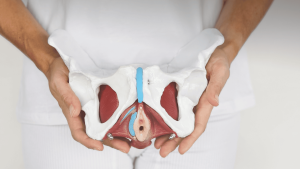
An anatomical crossroads with a sophisticated functional architecture
The pelvic floor is not simply a “supporting platform,” but a multilayered structure that integrates the strength of connective tissues with the finely tuned muscle “fans” of the levator ani complex. It is a diaphragm, but also a “regulator”: involved in abdomino-pelvic pressure gradients, respiratory dynamics, lumbar stability, and sexuality—both mechanically and proprioceptively. Its physiology is not limited to the capacity to contract and relax; it relies on a baseline “resting tone” that responds to posture, emotions, hormonal states, and pressure variations. It is a region where tensions accumulate and where weakness can take clinical forms that are sometimes silent, sometimes unmistakable.
The importance of the pelvic floor across the female lifespan
The individual’s hormonal, reproductive, and mechanical life shapes the pelvic floor slowly and, at times, through almost imperceptible progressive changes.
Youth represents a period of maximum elasticity and responsiveness, but it is not free from imbalances; pregnancy and childbirth represent the time of greatest strain, precisely due to the pressure to which the structures composing the pelvic floor are subjected during delivery.
Menopause marks the beginning of a period of tissue vulnerability that intertwines with the physiological myofascial involution.
Finally, senescence reveals its essential role, as tone loss—also due to estrogen deficiency—manifests as visceral fragility, continence alterations, and postural changes.
In the silent complexity of the pelvic floor, disorders never arise explosively: rather, they emerge as progressive cracks in a system that has long tried to maintain balance through subtle biomechanical compensations. It is rare for dysfunction to appear as an isolated event; more often, what seems like a “symptom” is actually the epiphenomenon of an entire chain of muscular, fascial, and neurological adaptations in progressive failure.
The SIUD and SIGO guidelines therefore do not identify generic signs, but true key indicators of a misalignment in pelvic physiology: three clinical phenomena which, although common, constitute as many alarm thresholds. Each of them does not merely describe a local malfunction; it points to a disruption in the fine modulation that governs continence, visceral integrity, and the harmony of the abdomino-pelvic core—hence the growing reference to the abdomino-lumbo-pelvic complex (CALP).
1. Stress urinary incontinence: a fracture in the anti-gravity mechanism
Stress urinary incontinence is not simply a “sphincter failure,” as it is often interpreted in common narratives. Rather, it is the revealing sign of a loss of synchronization between a sudden increase in intra-abdominal pressure and the pelvic floor’s continence response.
When a cough, sneeze, jump, or even a sporting exercise produces a pressure wave that does not meet an adequate muscular counterbalance, what becomes visible is not the event itself, but the deep vulnerability of the entire urethral support system.
This condition reflects musculature that is unable to modulate its baseline tone and to activate reflexively and promptly. Not infrequently, moreover, muscular weakness is compounded by connective tissue alterations—often invisible on superficial examination—that compromise the resilience of the urethral suspension structures. Stress incontinence thus takes shape as a failure of the body’s biomechanical intelligence, not as an isolated defect.
2. A sensation of pelvic heaviness: the silent language of early prolapse
The sensation of pelvic heaviness or pressure is an ambiguous, delicate, almost shy symptom—yet infinitely eloquent. It is often the first warning of prolapse in a prodromal phase, when pelvic organs begin—still almost imperceptibly—to lose the axial tension that supports them.
Many describe this perception as a “pulling downward” or a sense of deep fullness; it conveys the suffering of a fascial apparatus that can no longer contain and distribute forces, like an elastic tissue that has become worn out.
This is a symptom on the border between anatomy and sensoriality: it does not always coincide with a visible prolapse or one that is clinically evident or instrumentally documented, yet it often anticipates with surprising precision the beginning of organ descent. It is the body’s voice warning of structural fatigue before the clinical eye can truly detect and measure it. Precisely because of its “changeable” nature, it requires attentive listening, free of diagnostic oversimplifications.
3. Evacuation disorders: dyssynergia as a rupture of the internal rhythm
Among the three signals, evacuation disorders are perhaps the most complex to interpret. They reveal an alteration not only in strength, but in the functional choreography of the pelvic floor.
Defecation is one of the most finely coordinated processes in the human body: it requires the pelvic floor to temporarily abandon its containing role in order to assume that of director of release. When this alternation does not occur—when the levator ani remains hypertonic and “holds” instead of letting go—the person perceives incomplete emptying, the need for excessive straining, or the sensation that the body no longer responds to its own commands.
These disorders are not simple manifestations of constipation; rather, they represent a loss of the pelvic floor’s ability to modulate the transition between contraction and release. Behind them there is often a picture of abdomino-pelvic dyssynergia, a subtle yet stubborn form of internal “discord” among muscles that should cooperate harmoniously. It is the body’s physiology itself that, abruptly, seems to no longer remember its ancestral grammar.
Beyond the symptom: what these signs truly tell us
These three indicators, though different in clinical expression, reveal the same underlying matrix: a pelvic floor that has lost its functional intelligence—the almost invisible capacity to attune to breathing, posture, and visceral motility.
Each symptom is therefore a crack in the system, a variation in the body’s rhythm that deserves attention—not only to restore function, but to rebuild continuity between the deep body and subjective perception.
The pelvic floor, with its network of muscles, fasciae, and neurovegetative connections, is an area that holds both mechanics and bodily memory. When it signals its fragility—through incontinence, pelvic heaviness, or evacuation dyssynergia—it speaks not only of dysfunction, but brings to light the complexity of a body that is trying, often unsuccessfully, to remain intact. Pelviperineal health, by its nature, does not lend itself to simplification: it requires a medicine that is not only technical, but interpretative—capable of grasping the nuances and underlying dynamics of a district that regulates the boundary between inside and outside, between identity and physiology.
Within this framework, every woman is called to a decisive role: that of guardian of her own pelvic floor. Not in a prescriptive sense, but as an exercise in bodily awareness—listening to internal micro-variations and recognizing the signals the body emits long before a symptom “breaks out.” A woman who recognizes a change in her pelvic balance is not “reporting a problem”: she is practicing a form of embodied competence—the ability to read what moves within the deepest layers of her physiology.
In an era that often normalizes pelvic discomfort as inevitable—after childbirth, with aging, with menopause—the woman who directs attention to this region takes a stance of biological reclamation: she asserts her integrity as a non-negotiable element.
Alongside her, in a relationship that is not hierarchical but synergistic, stands the midwife—a professional figure whose task is not only technical, but profoundly cultural and embodied. The midwife represents the most sensitive interface between clinical care and lived experience: the one who knows female physiology not as a series of procedures, but as a dynamic geography—mobile, vulnerable, and powerful.
In her daily practice, the midwife becomes the guarantor of a medicine that does not merely correct, but accompanies, rebuilds, and restores meaning. Her intervention does not end with guiding education, re-education, and rehabilitation or with recognizing dysfunctions: she is the privileged witness to that process of bodily re-appropriation in which a woman stops perceiving herself as a “carrier of a disorder” and returns to being an active subject in her own pelvic health.
Thus, the cure and the care of the pelvic floor take the shape of an alliance: a woman who listens to herself, a body that speaks, a midwife who translates, supports, and restores the possibility of regained balance.
In this triad—body, awareness, care—dysfunction is no longer a failure, but the beginning of a different narrative, in which physiology stops being silence and returns to being a shared language: deeply human, deeply feminine.
